

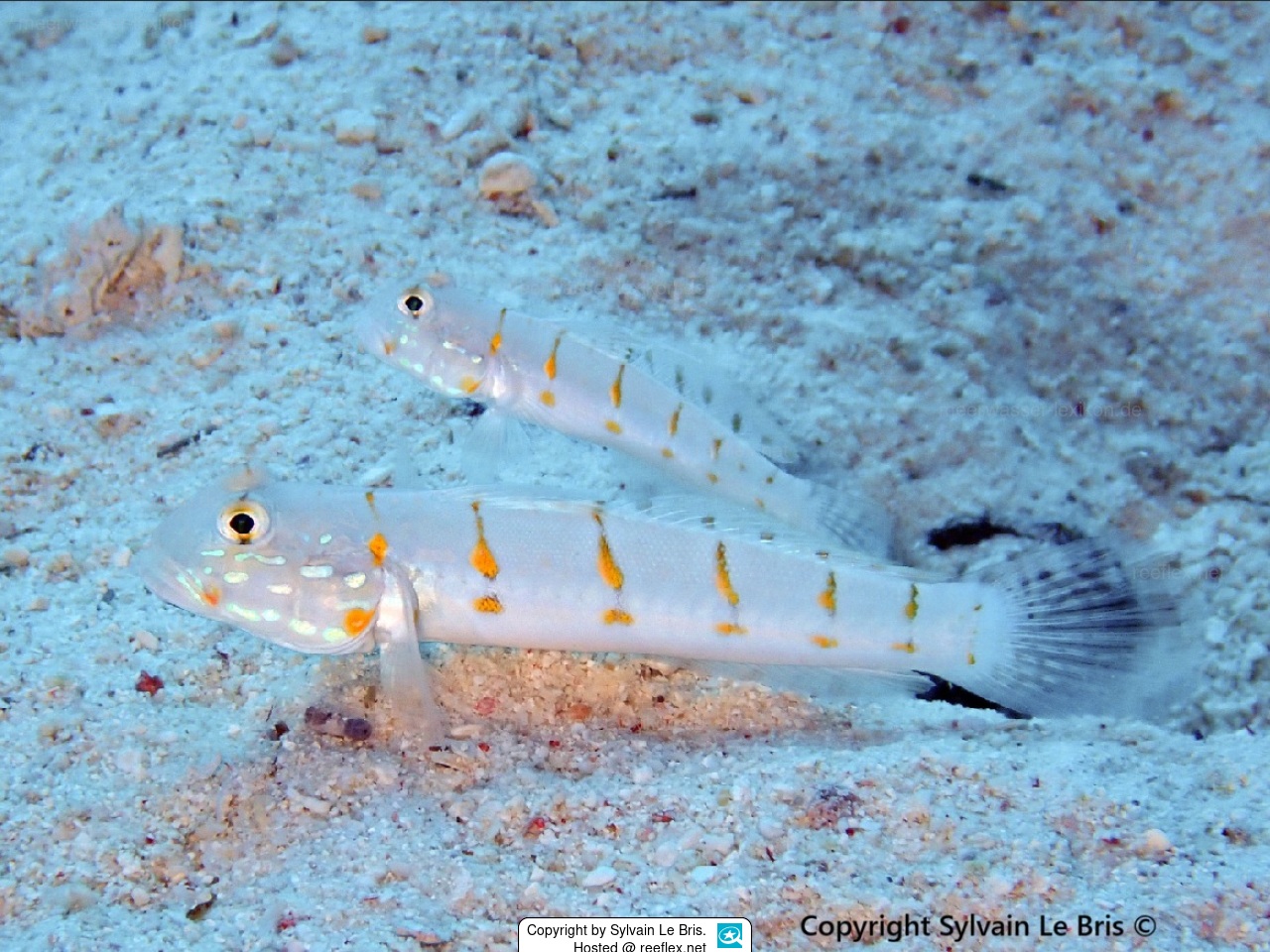
 Sylvain Le Bris, Frankreich


Info
In May 2026, two new species of Valenciennea gobies from the Indian Ocean were first described: Valenciennea schlieweni and Valenciennea schlieweni.
Valenciennea schlieweni inhabits clean, white sandy slopes, typically at depths of more than 20 meters, where the gobies occur in pairs, with each individual constructing its own burrow.
Adult fish are almost always observed in pairs, swimming close together near their burrows.
The coloration of living specimens from the western Indian Ocean (South Africa, Kenya, Tanzania, Comoros, Seychelles, Mauritius, Madagascar, Chagos Archipelago, Red Sea, Maldives, west coast of India) and the Andaman Sea (Sumatra and Thailand) is based on 50 photos from iNaturalist, GBIF, NrF-SAIAB, and the published literature:
The head and body are sandy white; on the lateral surface of the head there are three rows of horizontally elongated blue spots (with thin dark blue margins) and a broad, rather whitish band ventrally from the posterior end of the jaw to the tip of the gill cover
A second row runs dorsally from the area below the eye to the end of the gill cover, while a third row extends between them from the upper lip to the end of the gill cover.
The length of the spots varies from smaller than the pupil diameter to the eye diameter.
Sometimes a short row of 1–3 smaller blue spots can be seen on the sides of the neck behind the eye.
A faint yellowish-orange stripe, narrower than the diameter of the eye, is visible between the ventral and medial head rows—more distinct in specimens from the Maldives, the west coast of India, and the Andaman Sea—extending from the end of the lips to the end of the gill cover.
The yellow intensifies toward the front and back, forming two intense orange/brownish-orange spots.
The sides and top of the neck feature irregularly shaped, mostly rounded, orange spots that vary in size but are smaller than the diameter of the pupil.
The chin of the gobies is distinctly black.
A yellowish-orange stripe runs below the midline of the body, with blue borders above and below
A row of six oblique yellowish-orange stripes on the upper side, sloping backward and downward.
The first stripe runs above the body from one pectoral fin base to the other; the second stripe begins below the third and fourth dorsal fin rays.
The third stripe is located at the base of the second dorsal fin, and a fourth stripe below the center of the second dorsal fin (beginning below the sixth segmented ray).
The fifth stripe runs just below the end of the second dorsal fin, and the sixth stripe above the center of the caudal peduncle.
The stripes do not extend to the yellowish stripe (Tanzania, Kenya, Red Sea, Comoros, Mayotte, Madagascar, Seychelles, Chagos Archipelago, Thailand) or extend to the yellowish stripe (Madagascar, Maldives, West Indies, Sumatra, Thailand).
The spaces between each pair of oblique stripes feature a distinct yellowish-orange oval (horizontal) or round spot, often accompanied by 1–5 smaller, irregularly shaped yellowish-orange spots.
The body stripes are marked with five oval orange or brown spots at the junction with the stripes or just below the ventral end of the oblique stripe.
A narrow, interrupted orange stripe at the base of the caudal fin is usually interrupted in the dorsal and ventral portions.
The first dorsal fin is transparent with scattered yellow to yellowish-orange spots; the second dorsal fin is also transparent with a basal row of 5–6 obliquely elongated yellowish-orange to orange spots (the last spot is elongated and horizontal, extending close to the rear end of the last dorsal fin ray and surrounding it).
Sometimes faint yellowish, irregular oblique stripes are visible between the main spots.
The anal fin is translucent, colorless to whitish, with a white distal margin.
The pelvic fins are translucent; the pectoral fins are clear, and their base features a short yellowish-orange stripe with bluish-white margins, which aligns with the stripes on the head and body.
The caudal fin is translucent, without distinct narrow reddish stripes on the upper side; the proximal part of the caudal fin usually exhibits four vertical rows of yellowish-orange spots.
Valenciennea schlieweni differs from all conspecifics, including Valenciennea puellaris, by a unique color pattern in the living state.
Similarity to other species:
The closest genetic relatives of Valenciennea schlieweni are Valenciennea persica and Valenciennea puellaris.
Etymology:
The species name “schlieweni” was named in honor of Dr. Ulrich Schliewen, a German ichthyologist and curator of fish at the State Zoological Collection Munich (ZSM), in recognition of his contributions to the conservation and research of African fish diversity, particularly marine gobies.
A special thanks to Sylvain Le Bris for the truly amazing photo of a couple from Valenciennea schlieweni!
Valenciennea schlieweni inhabits clean, white sandy slopes, typically at depths of more than 20 meters, where the gobies occur in pairs, with each individual constructing its own burrow.
Adult fish are almost always observed in pairs, swimming close together near their burrows.
The coloration of living specimens from the western Indian Ocean (South Africa, Kenya, Tanzania, Comoros, Seychelles, Mauritius, Madagascar, Chagos Archipelago, Red Sea, Maldives, west coast of India) and the Andaman Sea (Sumatra and Thailand) is based on 50 photos from iNaturalist, GBIF, NrF-SAIAB, and the published literature:
The head and body are sandy white; on the lateral surface of the head there are three rows of horizontally elongated blue spots (with thin dark blue margins) and a broad, rather whitish band ventrally from the posterior end of the jaw to the tip of the gill cover
A second row runs dorsally from the area below the eye to the end of the gill cover, while a third row extends between them from the upper lip to the end of the gill cover.
The length of the spots varies from smaller than the pupil diameter to the eye diameter.
Sometimes a short row of 1–3 smaller blue spots can be seen on the sides of the neck behind the eye.
A faint yellowish-orange stripe, narrower than the diameter of the eye, is visible between the ventral and medial head rows—more distinct in specimens from the Maldives, the west coast of India, and the Andaman Sea—extending from the end of the lips to the end of the gill cover.
The yellow intensifies toward the front and back, forming two intense orange/brownish-orange spots.
The sides and top of the neck feature irregularly shaped, mostly rounded, orange spots that vary in size but are smaller than the diameter of the pupil.
The chin of the gobies is distinctly black.
A yellowish-orange stripe runs below the midline of the body, with blue borders above and below
A row of six oblique yellowish-orange stripes on the upper side, sloping backward and downward.
The first stripe runs above the body from one pectoral fin base to the other; the second stripe begins below the third and fourth dorsal fin rays.
The third stripe is located at the base of the second dorsal fin, and a fourth stripe below the center of the second dorsal fin (beginning below the sixth segmented ray).
The fifth stripe runs just below the end of the second dorsal fin, and the sixth stripe above the center of the caudal peduncle.
The stripes do not extend to the yellowish stripe (Tanzania, Kenya, Red Sea, Comoros, Mayotte, Madagascar, Seychelles, Chagos Archipelago, Thailand) or extend to the yellowish stripe (Madagascar, Maldives, West Indies, Sumatra, Thailand).
The spaces between each pair of oblique stripes feature a distinct yellowish-orange oval (horizontal) or round spot, often accompanied by 1–5 smaller, irregularly shaped yellowish-orange spots.
The body stripes are marked with five oval orange or brown spots at the junction with the stripes or just below the ventral end of the oblique stripe.
A narrow, interrupted orange stripe at the base of the caudal fin is usually interrupted in the dorsal and ventral portions.
The first dorsal fin is transparent with scattered yellow to yellowish-orange spots; the second dorsal fin is also transparent with a basal row of 5–6 obliquely elongated yellowish-orange to orange spots (the last spot is elongated and horizontal, extending close to the rear end of the last dorsal fin ray and surrounding it).
Sometimes faint yellowish, irregular oblique stripes are visible between the main spots.
The anal fin is translucent, colorless to whitish, with a white distal margin.
The pelvic fins are translucent; the pectoral fins are clear, and their base features a short yellowish-orange stripe with bluish-white margins, which aligns with the stripes on the head and body.
The caudal fin is translucent, without distinct narrow reddish stripes on the upper side; the proximal part of the caudal fin usually exhibits four vertical rows of yellowish-orange spots.
Valenciennea schlieweni differs from all conspecifics, including Valenciennea puellaris, by a unique color pattern in the living state.
Similarity to other species:
The closest genetic relatives of Valenciennea schlieweni are Valenciennea persica and Valenciennea puellaris.
Etymology:
The species name “schlieweni” was named in honor of Dr. Ulrich Schliewen, a German ichthyologist and curator of fish at the State Zoological Collection Munich (ZSM), in recognition of his contributions to the conservation and research of African fish diversity, particularly marine gobies.
A special thanks to Sylvain Le Bris for the truly amazing photo of a couple from Valenciennea schlieweni!

