Anzeige
Fauna Marin GmbH Tunze ICP Kölle Zoo Aquaristik BAS

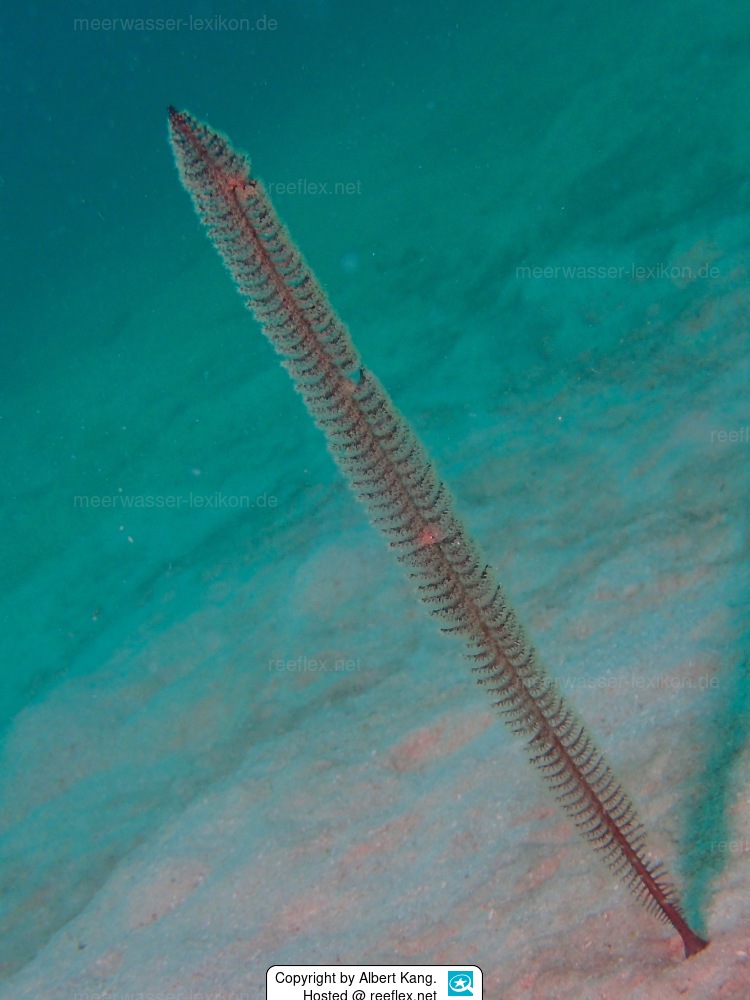
Scytalium tentaculatum Sea Feather, Sea Pen

Scytalium tentaculatum is commonly referred to as Sea Feather, Sea Pen. Difficulty in the aquarium: Wyłącznie dla ekspertów! Bardzo trudny w hodowli!. Toxicity: Toxic hazard unknown.


Profilbild Urheber Albert Kang, Philippinen

Foto: um Mabul Island, Malaysia

/12.12.2017
Courtesy of the author Albert Kang, Philippinen . Please visit www.inaturalist.org for more information.

Uploaded by AndiV.

Image detail


Profile

lexID:
18229 
AphiaID:
Scientific:
Scytalium tentaculatum 
German:
Seefeder 
English:
Sea Feather, Sea Pen 
Category:
Pióra morskie 
Family tree:
Animalia (Kingdom) > Cnidaria (Phylum) > Octocorallia (Class) > Scleralcyonacea (Order) > Virgulariidae (Family) > Scytalium (Genus) > tentaculatum (Species) 
Initial determination:
Kölliker, 1880 
Occurrence:
Andaman and Nicobar Islands, Bali, Borneo (Kalimantan), Celebes Sea, Coral sea (Eastern Australia), Indo Pacific, Indo-Pacific coral triangle, Indonesia, Lembeh Strait, Malaysia, Pakistan, Philippines, Queensland (Australia), Sulawesi, Timor, Tulamben 
Marine Zone:
Subtidal, sublittoral, infralittoral, deep zone of the oceans from the lower limit of the intertidal zone (intertidal) to the shelf edge at about 200 m water depth. neritic. 
Sea depth:
- 22 Meter 
Habitats:
Demersal (bottom-dwelling fish), Muddy grounds, Reef slopes, Rubble floors, Sandy sea floors 
Size:
up to 24.41" (62 cm) 
Temperature:
°F - 80.6 °F (°C - 27°C) 
Food:
azooxanthellat, nonphotosynthetic, Organic suspended sediment , Plankton, Suspension feeder 
Difficulty:
Wyłącznie dla ekspertów! Bardzo trudny w hodowli! 
Offspring:
Not available as offspring 
Toxicity:
Toxic hazard unknown 
CITES:
Not evaluated 
Red List:
Not evaluated (NE) 
Related species at
Catalog of Life
:
 
Author:
Publisher:
Meerwasser-Lexikon.de
Created:
Last edit:
2026-04-04 08:52:41 

Info

Scytalium tentaculatum is found throughout the Indo-Pacific and requires suitable soft substrates for settlement as well as currents that are not too turbulent.
The sea feather prefers to settle on gently sloping slopes and has not yet been observed in large groups.

This sea feather provides an important habitat for crabs, shrimp, and gobies, where these commensal inhabitants find both shelter and a continuous supply of food washed ashore.

Sea feathers are able to retreat into the substrate in a flash when they feel disturbed or when predators approach.

Pictures

Commonly


Husbandry know-how of owners

0 husbandary tips from our users available
Show all and discuss