

 PLoS ONE | www.plosone.org


Info
In 2022, an expedition was carried out with the ship “UnderSea Hunter Argo” and the submersible “DeepSee” to explore the biodiversity off the coast of Colombia in the eastern Pacific.
One of the areas specifically studied was the Navigator Bank in the Yuruparí Ridge, located northwest of the Malpelo Ridge and Malpelo Island and south of the Cordillera de Coiba Managed Resources Area (ARMCC) in Panamanian waters.
The discovery of the new species was made possible thanks to a joint expedition by Colombian and international researchers as part of the National Geographic Pristine Seas initiative.
In this area, characterized by ridges and seamounts, various samples were taken using the hydraulic arm of the manned submersible, including a previously unknown filigree coral, which is the first coral species of this genus to be discovered in this region at depths between 160 and 260 meters.
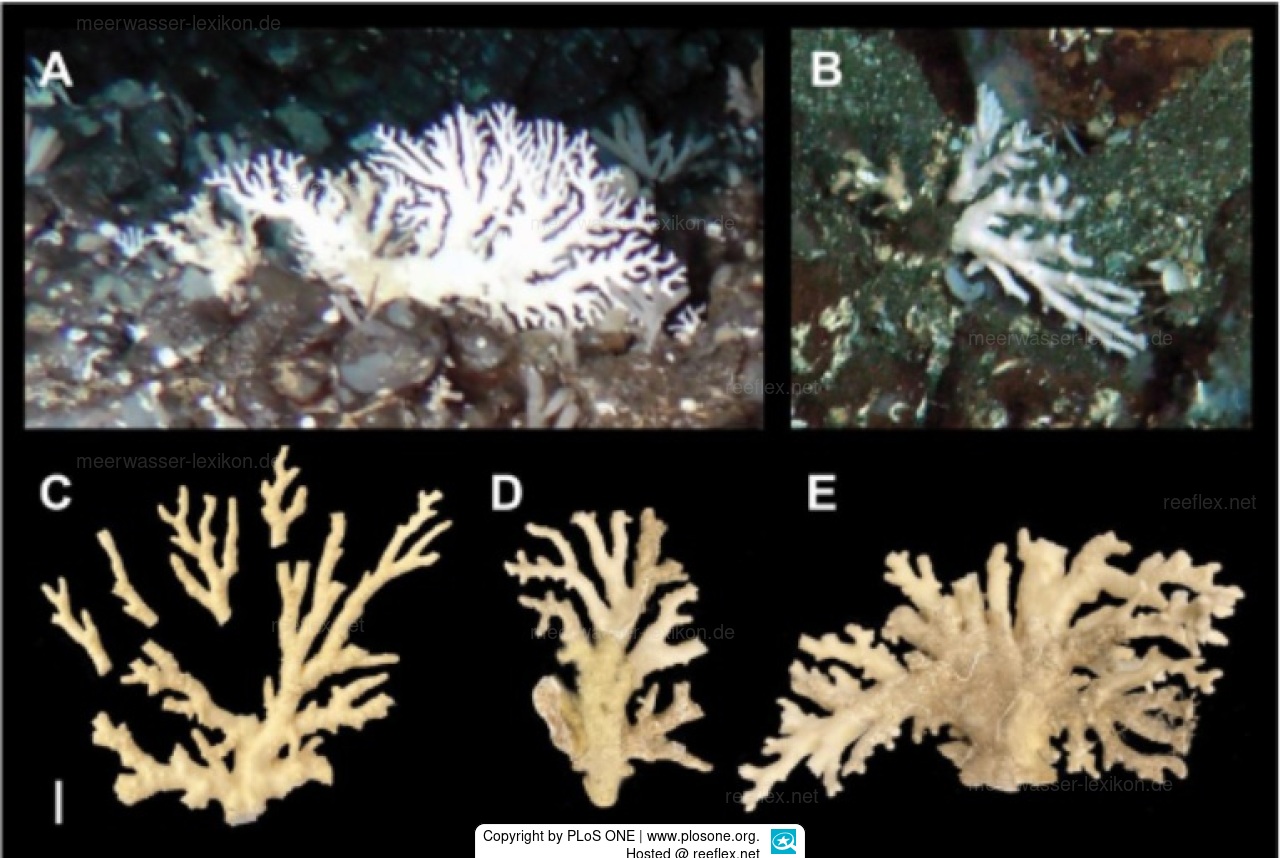
The colonies of the new azooxanthellate filigree coral are mostly flat, fan-shaped with dichotomous branching, and wider than they are tall.
The holotype (YU006-ANDES8753) measures approximately 100 mm in height and 80 mm in width.
However, underwater photographs taken at the same depth as the collection show slightly larger colonies with a height of approximately 120 mm and a width of 180 mm.
The branches are flattened with blunt tips and slightly thinner than the branch width.
The tissue is white, and the underwater photographs show a color variation in some colonies, which are white with a pinkish tinge, but white colonies dominate the seascape.
Nutrition:
Filigree colonies have two types of polyps, dactylozooids and gastrozooids, which serve to capture prey and digest food, as well as defend against predators.
Reproduction:
Distichopora yurupariensis has female ampullae (large hemispherical mounds with radial grooves and a diameter of 1.00–1.25 mm) and male ampullae (low mounds, smaller than the female ampullae, with diameters of 0.41–0.57 mm).
Female and male ampullae have large surface pores.
Disadvantage of internal reproduction:
Unlike spawning corals, which release their gametes into the surrounding seawater where they can drift away, the reproduction of filigree coral remains spatially limited.
According to National Geographic, Colombian marine scientist Juan Mayorga initially assumed he had discovered a common Stylaster coral, recognizable by its pale coloration. However, when marine biologist Luisa Dueñas from the National University of Colombia examined it more closely, they realized that it was actually a completely new species of coral that had not yet been scientifically described.
This previously little-studied underwater region preserves ecosystems that have remained relatively intact thanks to their difficult accessibility and depth.
Researchers believe that these conditions may make the new coral endemic to the region, meaning that it is found exclusively in this area. Its discovery not only enriches Colombia's marine inventory, but also highlights the importance of protecting little-known habitats that may harbour species unique to science.
According to experts, this discovery represents a fundamental advance in marine biology and is a wake-up call for the need to strengthen the protection of deep-sea ecosystems. Deep-sea corals perform important ecological functions: they serve as refuges for fish and crustaceans, stabilize the seabed, and participate in the ocean's biogeochemical cycles.
Despite its remote location, fishing has already begun to impact the area, adding to global risks such as climate change, ocean acidification, and pollution. For this reason, scientists have proposed including Bajo Navegador in the Malpelo Flora and Fauna Sanctuary, one of the country's most important marine reserves, to ensure better protection for the new corals and other species that live in deep waters.
The discovery of Distichopora yurupariensis expands the great diversity of corals in Colombian waters.
With the discovery of this new deep-sea coral, the country is now expanding its marine wealth and reaffirming its position as one of the most biodiverse nations in the world.
Etymology:
The species name “yurupariensis” refers to the type locality, the Yuruparí Ridge.
Literature reference:
Luisa F. Dueñas, Stephen D. Cairns, Juan S. Mayorga, Juan A. Sánchez
Distichopora yurupariensis, a New Species of Stylasteridae (Cnidaria: Hydrozoa: Anthoathecata) from the Upper Bathyal Tropical Eastern Pacific
Pacific Science, 79(1):97-104 (2025). https://doi.org/10.2984/79.1.5
One of the areas specifically studied was the Navigator Bank in the Yuruparí Ridge, located northwest of the Malpelo Ridge and Malpelo Island and south of the Cordillera de Coiba Managed Resources Area (ARMCC) in Panamanian waters.
The discovery of the new species was made possible thanks to a joint expedition by Colombian and international researchers as part of the National Geographic Pristine Seas initiative.
In this area, characterized by ridges and seamounts, various samples were taken using the hydraulic arm of the manned submersible, including a previously unknown filigree coral, which is the first coral species of this genus to be discovered in this region at depths between 160 and 260 meters.
The colonies of the new azooxanthellate filigree coral are mostly flat, fan-shaped with dichotomous branching, and wider than they are tall.
The holotype (YU006-ANDES8753) measures approximately 100 mm in height and 80 mm in width.
However, underwater photographs taken at the same depth as the collection show slightly larger colonies with a height of approximately 120 mm and a width of 180 mm.
The branches are flattened with blunt tips and slightly thinner than the branch width.
The tissue is white, and the underwater photographs show a color variation in some colonies, which are white with a pinkish tinge, but white colonies dominate the seascape.
Nutrition:
Filigree colonies have two types of polyps, dactylozooids and gastrozooids, which serve to capture prey and digest food, as well as defend against predators.
Reproduction:
Distichopora yurupariensis has female ampullae (large hemispherical mounds with radial grooves and a diameter of 1.00–1.25 mm) and male ampullae (low mounds, smaller than the female ampullae, with diameters of 0.41–0.57 mm).
Female and male ampullae have large surface pores.
Disadvantage of internal reproduction:
Unlike spawning corals, which release their gametes into the surrounding seawater where they can drift away, the reproduction of filigree coral remains spatially limited.
According to National Geographic, Colombian marine scientist Juan Mayorga initially assumed he had discovered a common Stylaster coral, recognizable by its pale coloration. However, when marine biologist Luisa Dueñas from the National University of Colombia examined it more closely, they realized that it was actually a completely new species of coral that had not yet been scientifically described.
This previously little-studied underwater region preserves ecosystems that have remained relatively intact thanks to their difficult accessibility and depth.
Researchers believe that these conditions may make the new coral endemic to the region, meaning that it is found exclusively in this area. Its discovery not only enriches Colombia's marine inventory, but also highlights the importance of protecting little-known habitats that may harbour species unique to science.
According to experts, this discovery represents a fundamental advance in marine biology and is a wake-up call for the need to strengthen the protection of deep-sea ecosystems. Deep-sea corals perform important ecological functions: they serve as refuges for fish and crustaceans, stabilize the seabed, and participate in the ocean's biogeochemical cycles.
Despite its remote location, fishing has already begun to impact the area, adding to global risks such as climate change, ocean acidification, and pollution. For this reason, scientists have proposed including Bajo Navegador in the Malpelo Flora and Fauna Sanctuary, one of the country's most important marine reserves, to ensure better protection for the new corals and other species that live in deep waters.
The discovery of Distichopora yurupariensis expands the great diversity of corals in Colombian waters.
With the discovery of this new deep-sea coral, the country is now expanding its marine wealth and reaffirming its position as one of the most biodiverse nations in the world.
Etymology:
The species name “yurupariensis” refers to the type locality, the Yuruparí Ridge.
Literature reference:
Luisa F. Dueñas, Stephen D. Cairns, Juan S. Mayorga, Juan A. Sánchez
Distichopora yurupariensis, a New Species of Stylasteridae (Cnidaria: Hydrozoa: Anthoathecata) from the Upper Bathyal Tropical Eastern Pacific
Pacific Science, 79(1):97-104 (2025). https://doi.org/10.2984/79.1.5

