


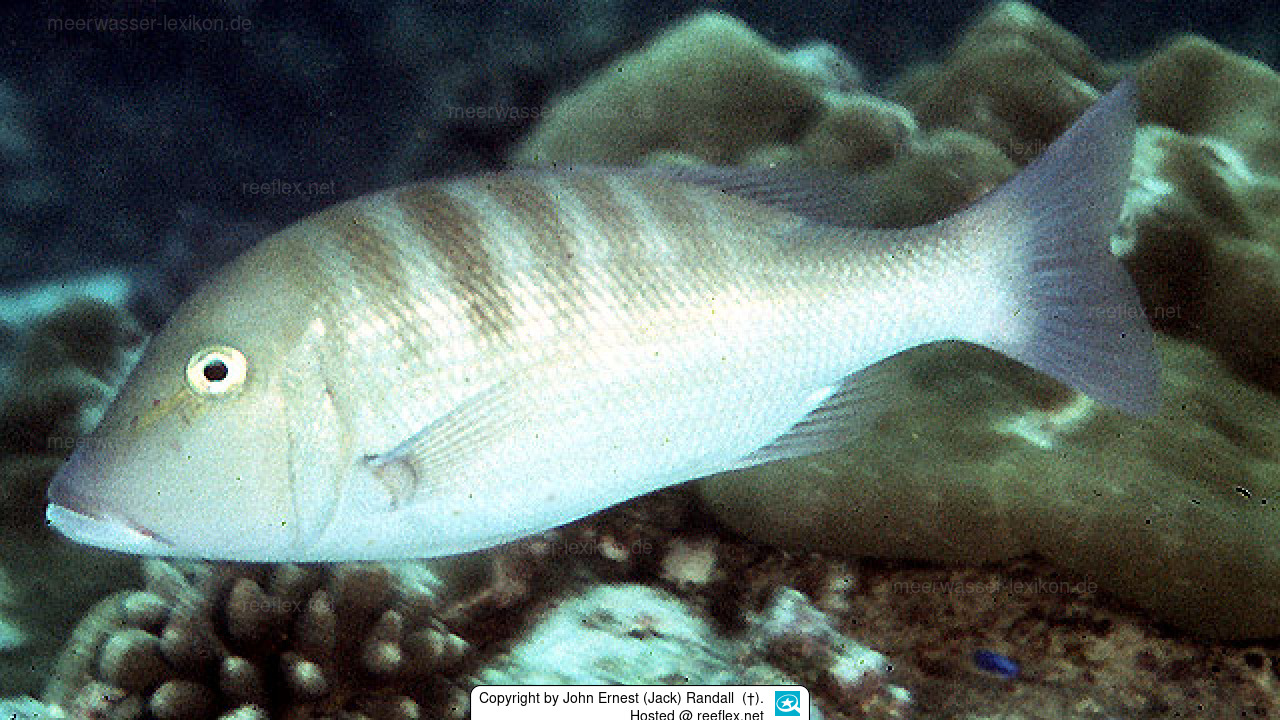
 Dr. John Ernest (Jack) Randall (†), Hawaii


Info
So far, Lethrinus enigmaticus has only been found in seagrass beds, coral reefs, and adjacent sandy areas down to a depth of 50 meters.
The street sweeper feeds mainly on echinoderms, crustaceans, and fish, and to a lesser extent on mollusks.
A peak in its reproduction was observed in October in Saya de Malha, but this study did not cover all periods of the year.
For the population in Saya de Malha, it has been confirmed that females are smaller and more numerous than males.
The body of the snapper is yellowish-bronze or gray, lighter on the ventral side, sometimes with three bronze stripes on the lower sides and seven to nine dark stripes on the upper sides.
The head is gray, brown, or bronze, sometimes with a series of yellowish transverse stripes on the upper head and snout.
A light stripe runs from the eye to the front nostril, and the lower edge of the eye socket has dark purple spots.
The upper jaw is reddish, the fins are pale, yellowish, or bronze.
Lethrinus enigmaticus is a popular sport fish for anglers, it is also caught in fish traps and sold for consumption at regional fish markets.
According to the IUCN, Lethrinus enigmaticus is commercially fished as a food fish.
Distribution: The snapper is likely to be found in other locations.
Etymology:
According to https://etyfish.org/, the species name “enigmaticus” is puzzling, reflecting Smith's uncertainty regarding the identity of the type specimen, which he has “provisionally described as new.”
The street sweeper feeds mainly on echinoderms, crustaceans, and fish, and to a lesser extent on mollusks.
A peak in its reproduction was observed in October in Saya de Malha, but this study did not cover all periods of the year.
For the population in Saya de Malha, it has been confirmed that females are smaller and more numerous than males.
The body of the snapper is yellowish-bronze or gray, lighter on the ventral side, sometimes with three bronze stripes on the lower sides and seven to nine dark stripes on the upper sides.
The head is gray, brown, or bronze, sometimes with a series of yellowish transverse stripes on the upper head and snout.
A light stripe runs from the eye to the front nostril, and the lower edge of the eye socket has dark purple spots.
The upper jaw is reddish, the fins are pale, yellowish, or bronze.
Lethrinus enigmaticus is a popular sport fish for anglers, it is also caught in fish traps and sold for consumption at regional fish markets.
According to the IUCN, Lethrinus enigmaticus is commercially fished as a food fish.
Distribution: The snapper is likely to be found in other locations.
Etymology:
According to https://etyfish.org/, the species name “enigmaticus” is puzzling, reflecting Smith's uncertainty regarding the identity of the type specimen, which he has “provisionally described as new.”

