


 ZooKeys


Info
The genus Trochus is very diverse, and identification at the species level is often difficult.
Some species, such as Trochus firmus, Trochus erythreus, Trochus flammulatus, and Trochus maculatus, have very similar shell morphologies, making it difficult to distinguish them based on external characteristics alone. In addition, some initial descriptions are incomplete.
New turban shells are identified by morphological characteristics of the shells, supported by 3D modeling techniques, and mainly by DNA barcoding.
Trochus nanhai and the new species Trochus parvus, also discovered there, were collected and identified from coral reef habitats in the South China Sea.
Description of the shell:
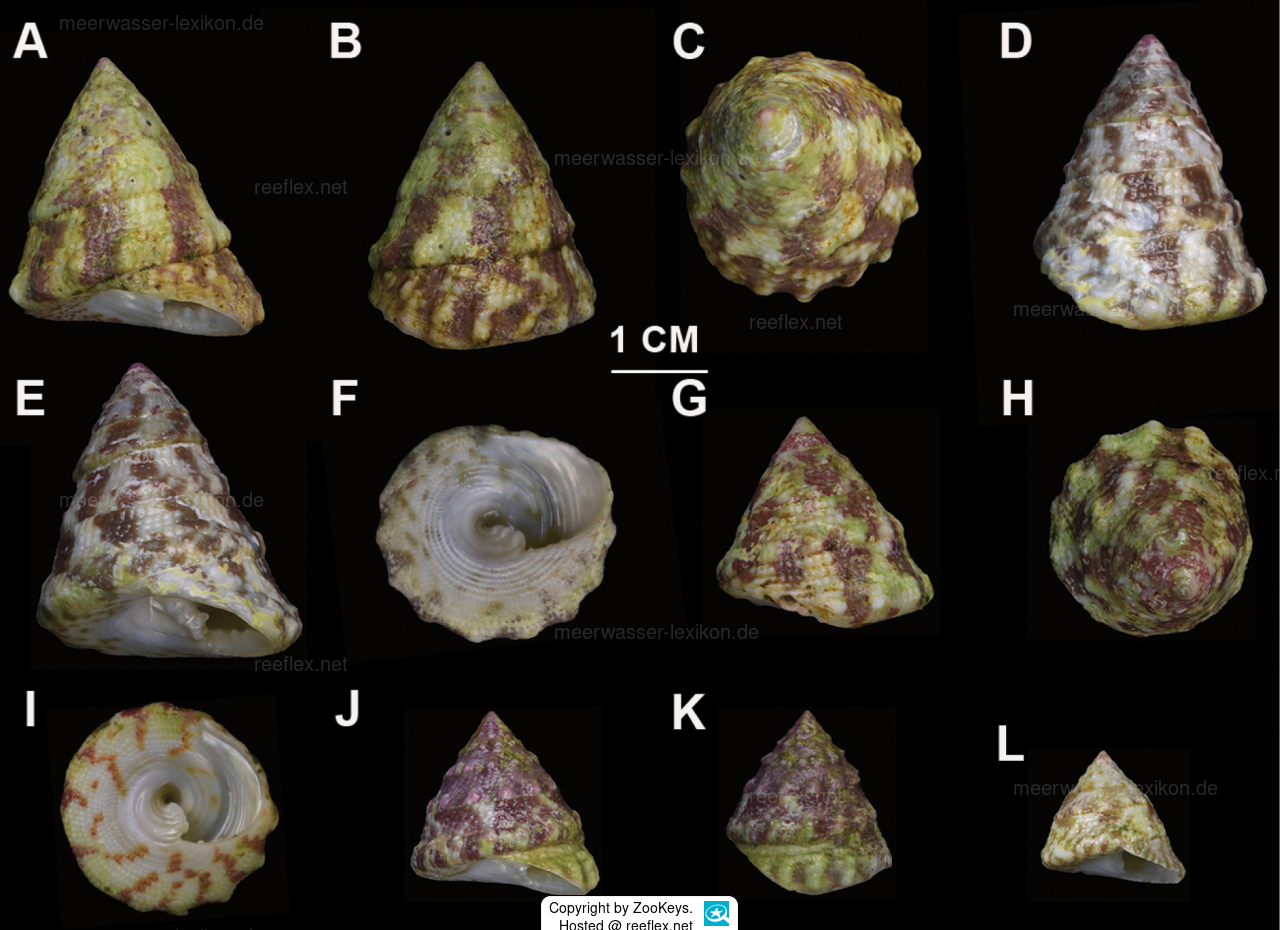
It is a medium-sized, elat-conical and low-conical, solid and heavy shell with a false umbilical depression.
The spiral consists of 7–8 flat whorls with 4–5 regular, closely spaced spiral rows of uniform granules on each whorl.
These granules are round, pearl-like, or slightly compressed.
The margin of each whorl has conspicuous, evenly distributed pustules, which are however barely visible in small subadult animals
In elat-conical specimens, the pustules of the whorls gradually merge during growth, resulting in smoother and more continuous spiral grooves.
The margin of the body whorl ring has 12–15 distinct longitudinal folds that form elongated nodules.
The base of the shell is slightly concave and sculptured with 11–12 concentric granular liration.
The upper side has distinct, broad reddish-brown longitudinal stripes, the width of which roughly corresponds to that of the alternating whitish bands.
The base has a narrow row of spots corresponding to the outer color pattern.
The inner lip is thickened and has 3–4 folds.
The columella bears 4–5 folded teeth.
Inside, the shell has a pearlescent sheen, accompanied by distinct spiral lirae.
The shells examined reached a height of 12.9–27.8 mm and a shell width of 14.0–24.9 mm.
Description of the radula:
The radula has a central tooth with a V-shaped tip and a broad trapezoidal shaft, flanked symmetrically by eight smaller teeth, each bearing 3–5 teeth on one side.
The fifth lateral tooth has a distinct paddle-shaped tip.
The marginal teeth are narrow and sickle-shaped; the innermost 9–12 marginal teeth each bear 2–3 teeth.
From the 10th to the 13th marginal tooth, the tooth size gradually decreases, while the number of teeth increases, forming a comb or feather-like structures.
The fifth lateral tooth has a distinct paddle-shaped tip.
The marginal teeth are narrow and sickle-shaped; the innermost 9–12 marginal teeth each carry 2–3 denticles.
From the 10th to the 13th marginal tooth, the tooth size gradually decreases, while the number of denticles increases, forming a crest or feather-like structures.
Precise details regarding the weight of the animals, the water depth, and the water temperature are missing from the initial description.
Etymology:
The species name “nanhai” is derived from the Chinese name for the South China Sea, the only region where this species has been found to date.
Literature reference:
Zhu P-J, Yan C-R, Yang H-Q, Hu L-S, Dong Y-W (2025)
Description of two new species of the genus Trochus Linnaeus, 1758 (Gastropoda, Trochidae) from the South China Sea. ZooKeys 1264: 265-280.
https://doi.org/10.3897/zookeys.1264.167854
This is an open access article distributed under the terms of the Creative Commons Attribution License (CC BY 4.0), which permits unrestricted use, distribution, and reproduction in any medium, provided the original author and source are credited.
The term "reef safe" is often used in marine aquaristics, especially when buying a new species people often ask if the new animal is "reef safe".
What exactly does reef safe mean?
To answer this question, you can ask target-oriented questions and inquire in forums, clubs, dealers and with aquarist friends:
- Are there already experiences and keeping reports that assure that the new animal can live in other suitably equipped aquariums without ever having caused problems?
- Is there any experience of invertebrates (crustaceans, hermits, mussels, snails) or corals being attacked by other inhabitants such as fish of the same or a different species?
- Is any information known or expected about a possible change in dietary habits, e.g., from a plant-based diet to a meat-based diet?
- Do the desired animals leave the reef structure "alone", do they constantly change it (boring starfish, digger gobies, parrotfish, triggerfish) and thus disturb or displace other co-inhabitants?
- do new animals tend to get diseases repeatedly and very quickly and can they be treated?
- Do known peaceful animals change their character in the course of their life and become aggressive?
- Can the death of a new animal possibly even lead to the death of the rest of the stock through poisoning (possible with some species of sea cucumbers)?
- Last but not least the keeper of the animals has to be included in the "reef safety", there are actively poisonous, passively poisonous animals, animals that have dangerous biting or stinging weapons, animals with extremely strong nettle poisons, these have to be (er)known and a plan of action should have been made in advance in case of an attack on the aquarist (e.g. telephone numbers of the poison control center, the treating doctor, the tropical institute etc.).
If all questions are evaluated positively in the sense of the animal(s) and the keeper, then one can assume a "reef safety".
Some species, such as Trochus firmus, Trochus erythreus, Trochus flammulatus, and Trochus maculatus, have very similar shell morphologies, making it difficult to distinguish them based on external characteristics alone. In addition, some initial descriptions are incomplete.
New turban shells are identified by morphological characteristics of the shells, supported by 3D modeling techniques, and mainly by DNA barcoding.
Trochus nanhai and the new species Trochus parvus, also discovered there, were collected and identified from coral reef habitats in the South China Sea.
Description of the shell:
It is a medium-sized, elat-conical and low-conical, solid and heavy shell with a false umbilical depression.
The spiral consists of 7–8 flat whorls with 4–5 regular, closely spaced spiral rows of uniform granules on each whorl.
These granules are round, pearl-like, or slightly compressed.
The margin of each whorl has conspicuous, evenly distributed pustules, which are however barely visible in small subadult animals
In elat-conical specimens, the pustules of the whorls gradually merge during growth, resulting in smoother and more continuous spiral grooves.
The margin of the body whorl ring has 12–15 distinct longitudinal folds that form elongated nodules.
The base of the shell is slightly concave and sculptured with 11–12 concentric granular liration.
The upper side has distinct, broad reddish-brown longitudinal stripes, the width of which roughly corresponds to that of the alternating whitish bands.
The base has a narrow row of spots corresponding to the outer color pattern.
The inner lip is thickened and has 3–4 folds.
The columella bears 4–5 folded teeth.
Inside, the shell has a pearlescent sheen, accompanied by distinct spiral lirae.
The shells examined reached a height of 12.9–27.8 mm and a shell width of 14.0–24.9 mm.
Description of the radula:
The radula has a central tooth with a V-shaped tip and a broad trapezoidal shaft, flanked symmetrically by eight smaller teeth, each bearing 3–5 teeth on one side.
The fifth lateral tooth has a distinct paddle-shaped tip.
The marginal teeth are narrow and sickle-shaped; the innermost 9–12 marginal teeth each bear 2–3 teeth.
From the 10th to the 13th marginal tooth, the tooth size gradually decreases, while the number of teeth increases, forming a comb or feather-like structures.
The fifth lateral tooth has a distinct paddle-shaped tip.
The marginal teeth are narrow and sickle-shaped; the innermost 9–12 marginal teeth each carry 2–3 denticles.
From the 10th to the 13th marginal tooth, the tooth size gradually decreases, while the number of denticles increases, forming a crest or feather-like structures.
Precise details regarding the weight of the animals, the water depth, and the water temperature are missing from the initial description.
Etymology:
The species name “nanhai” is derived from the Chinese name for the South China Sea, the only region where this species has been found to date.
Literature reference:
Zhu P-J, Yan C-R, Yang H-Q, Hu L-S, Dong Y-W (2025)
Description of two new species of the genus Trochus Linnaeus, 1758 (Gastropoda, Trochidae) from the South China Sea. ZooKeys 1264: 265-280.
https://doi.org/10.3897/zookeys.1264.167854
This is an open access article distributed under the terms of the Creative Commons Attribution License (CC BY 4.0), which permits unrestricted use, distribution, and reproduction in any medium, provided the original author and source are credited.
The term "reef safe" is often used in marine aquaristics, especially when buying a new species people often ask if the new animal is "reef safe".
What exactly does reef safe mean?
To answer this question, you can ask target-oriented questions and inquire in forums, clubs, dealers and with aquarist friends:
- Are there already experiences and keeping reports that assure that the new animal can live in other suitably equipped aquariums without ever having caused problems?
- Is there any experience of invertebrates (crustaceans, hermits, mussels, snails) or corals being attacked by other inhabitants such as fish of the same or a different species?
- Is any information known or expected about a possible change in dietary habits, e.g., from a plant-based diet to a meat-based diet?
- Do the desired animals leave the reef structure "alone", do they constantly change it (boring starfish, digger gobies, parrotfish, triggerfish) and thus disturb or displace other co-inhabitants?
- do new animals tend to get diseases repeatedly and very quickly and can they be treated?
- Do known peaceful animals change their character in the course of their life and become aggressive?
- Can the death of a new animal possibly even lead to the death of the rest of the stock through poisoning (possible with some species of sea cucumbers)?
- Last but not least the keeper of the animals has to be included in the "reef safety", there are actively poisonous, passively poisonous animals, animals that have dangerous biting or stinging weapons, animals with extremely strong nettle poisons, these have to be (er)known and a plan of action should have been made in advance in case of an attack on the aquarist (e.g. telephone numbers of the poison control center, the treating doctor, the tropical institute etc.).
If all questions are evaluated positively in the sense of the animal(s) and the keeper, then one can assume a "reef safety".

