

 Scott & Jeanette Johnson, Kwajalein Unterwater

Info
The original name of this bryozoan was Sertularia trigonostoma Busk, 1852
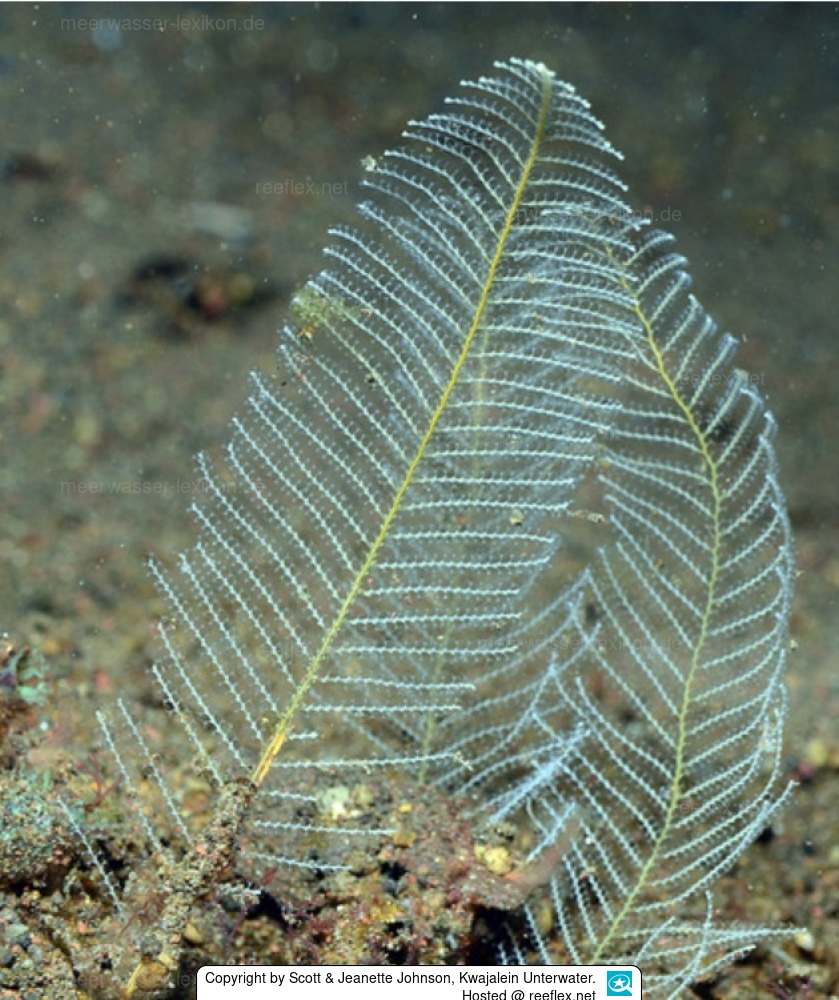
The hydrorhiza of Tridentata trigonostoma is tubular, thus enveloping the settlement substrate.
The stem is up to 85 mm long, pinnate, loose, monosiphonal, and the stem diameter decreases distally
The perisarc is thick, the proximal area of longer stems is without hydrocladia, shorter stems are completely covered with hydrocladia.
Hydrocladia alternate, arising at an angle of approx. 40° to the stem axis, longest in the proximal stem area (up to 10 mm long on the tallest stems), becoming shorter distally;
Hydrocladium inserted on a long apophysis with a distinct transverse distal node; two hydrothecae between each hydrocladium on the same side, another in the axil.
Hydrocladiales internode with two hydrothecae, node transverse to slightly oblique, distinct.
Hydrothecae in two rows, almost opposite, sitting on the front of the internode, almost opposite, slightly separated from each other in the proximal region of the hydrocladium, adcauline walls connected distally along the hydrocladium.
Hydrotheca longer than wide, adcauline wall convex, free part very short, abcauline wall straight to slightly twisted or concave, adjacent to internode, base of adcauline wall with an inward-facing node of perisarc, no true base of hydrotheca, connection with hydrocladium broad.
Edge thickened with two lobed lateral tubercles and a much smaller adcauline tubercle, opening elliptical, operculum remnants covering most of the edges.
Hydanthes without appendix; about 16 tentacles.
Gonotheca immature, balloon-shaped to irregularly cylindrical, without a stalk, inserted between two cauline hydrothecae in the middle to upper stem region, expanding apically to a blunt distal end, gonophor an aborted hydanthe, perisarc extremely thin.
Color: Pale yellow-brown.
Synonym: Sertularella trigonostomata (Busk, 1852) · unaccepted > misspelling - incorrect subsequent spelling (mispelling and wrong genus ?
The hydrorhiza of Tridentata trigonostoma is tubular, thus enveloping the settlement substrate.
The stem is up to 85 mm long, pinnate, loose, monosiphonal, and the stem diameter decreases distally
The perisarc is thick, the proximal area of longer stems is without hydrocladia, shorter stems are completely covered with hydrocladia.
Hydrocladia alternate, arising at an angle of approx. 40° to the stem axis, longest in the proximal stem area (up to 10 mm long on the tallest stems), becoming shorter distally;
Hydrocladium inserted on a long apophysis with a distinct transverse distal node; two hydrothecae between each hydrocladium on the same side, another in the axil.
Hydrocladiales internode with two hydrothecae, node transverse to slightly oblique, distinct.
Hydrothecae in two rows, almost opposite, sitting on the front of the internode, almost opposite, slightly separated from each other in the proximal region of the hydrocladium, adcauline walls connected distally along the hydrocladium.
Hydrotheca longer than wide, adcauline wall convex, free part very short, abcauline wall straight to slightly twisted or concave, adjacent to internode, base of adcauline wall with an inward-facing node of perisarc, no true base of hydrotheca, connection with hydrocladium broad.
Edge thickened with two lobed lateral tubercles and a much smaller adcauline tubercle, opening elliptical, operculum remnants covering most of the edges.
Hydanthes without appendix; about 16 tentacles.
Gonotheca immature, balloon-shaped to irregularly cylindrical, without a stalk, inserted between two cauline hydrothecae in the middle to upper stem region, expanding apically to a blunt distal end, gonophor an aborted hydanthe, perisarc extremely thin.
Color: Pale yellow-brown.
Synonym: Sertularella trigonostomata (Busk, 1852) · unaccepted > misspelling - incorrect subsequent spelling (mispelling and wrong genus ?

