


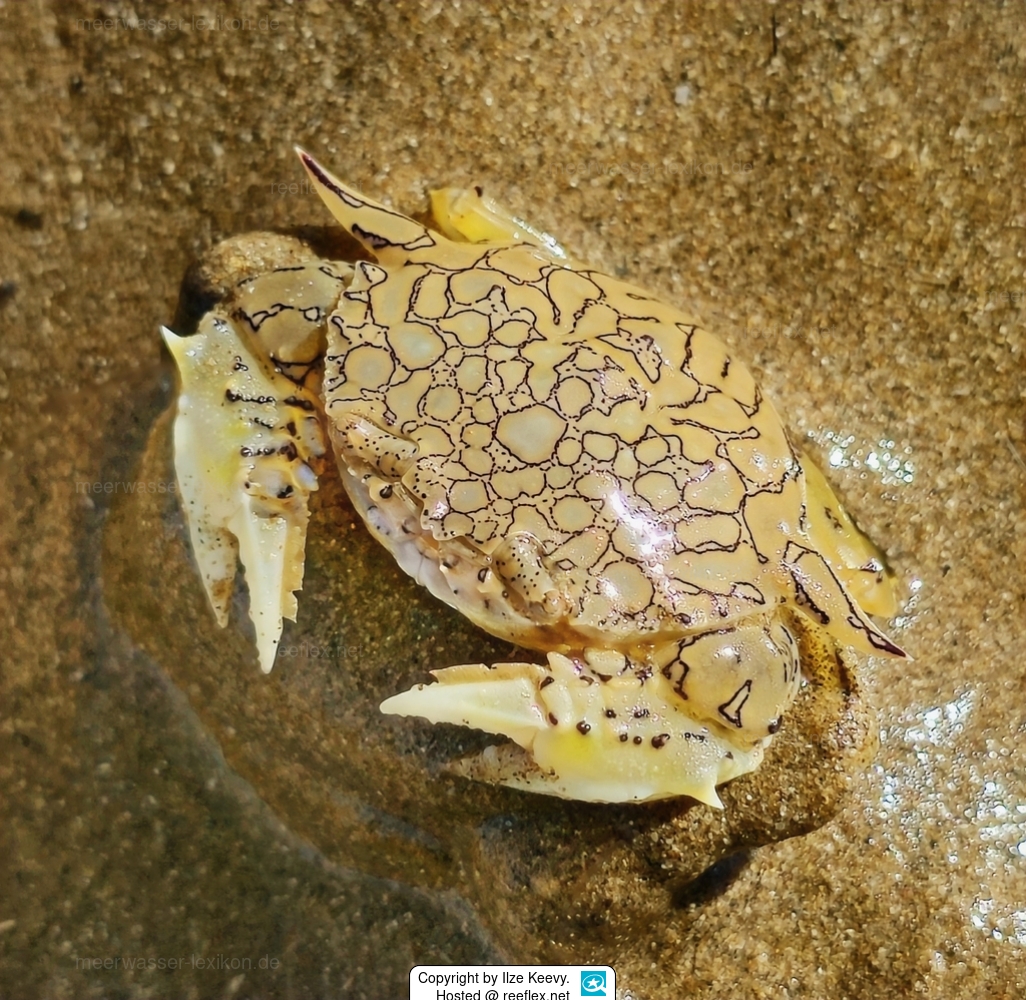
 Dr. Ilze Keevy, Australien


Info
Matuta planipes Fabricius, 1798
A crab in the family Matutidae. This is a family of crabs also known as moon crabs. Moon crabs can swim, but they also burrow. They differ from the swimming crabs of the family Portunidae in that all five pairs of legs are flattened, rather than just the last pair forming paddles, as in the swimming crabs of the family Portunidae. Moon crabs are nocturnal, aggressive predators. They are mostly found on sandy substrates. The name "moon crabs" refers to the bright, round carapace, which is said to resemble a round moon.
Thanks to their paddle-like legs, moon crabs are not only good swimmers, but they are also excellent at digging in the sand. They work like spades and make the crab disappear into the sand very quickly. Most moon crabs feed on small invertebrates or scavengers.
Moon crabs reproduce sexually. Females usually differ from males in having a broader abdomen. This is an adaptation that allows them to carry the eggs under their abdomen until hatching. During the breeding season, the larger male can often be seen holding down a much smaller, immature female and protecting her from other competing suitors. The little female will soon molt and develop into an adult female, and the male will then mate with her.
Synonymised names
Cancer americanus Seba, 1758 · unaccepted > unavailable name (pre-Linnaean name)
Cancer lunaris Herbst, 1783 · unaccepted > junior subjective synonym
Cancer planipes Weber, 1795 · unaccepted > nomen nudum
Matuta appendiculata Bosc & Desmarest, 1830 · unaccepted > junior subjective synonym
Matuta flagra Shen, 1936 · unaccepted > junior subjective synonym
Matuta laevidactyla Miers, 1880 · unaccepted > junior subjective synonym
Matuta lineifera Miers, 1877 · unaccepted > junior subjective synonym
Matuta rubrolineata Miers, 1877 · unaccepted > junior subjective synonym
Matuta rubro-lineata Miers, 1877 · unaccepted > misspelling - incorrect original spelling
A crab in the family Matutidae. This is a family of crabs also known as moon crabs. Moon crabs can swim, but they also burrow. They differ from the swimming crabs of the family Portunidae in that all five pairs of legs are flattened, rather than just the last pair forming paddles, as in the swimming crabs of the family Portunidae. Moon crabs are nocturnal, aggressive predators. They are mostly found on sandy substrates. The name "moon crabs" refers to the bright, round carapace, which is said to resemble a round moon.
Thanks to their paddle-like legs, moon crabs are not only good swimmers, but they are also excellent at digging in the sand. They work like spades and make the crab disappear into the sand very quickly. Most moon crabs feed on small invertebrates or scavengers.
Moon crabs reproduce sexually. Females usually differ from males in having a broader abdomen. This is an adaptation that allows them to carry the eggs under their abdomen until hatching. During the breeding season, the larger male can often be seen holding down a much smaller, immature female and protecting her from other competing suitors. The little female will soon molt and develop into an adult female, and the male will then mate with her.
Synonymised names
Cancer americanus Seba, 1758 · unaccepted > unavailable name (pre-Linnaean name)
Cancer lunaris Herbst, 1783 · unaccepted > junior subjective synonym
Cancer planipes Weber, 1795 · unaccepted > nomen nudum
Matuta appendiculata Bosc & Desmarest, 1830 · unaccepted > junior subjective synonym
Matuta flagra Shen, 1936 · unaccepted > junior subjective synonym
Matuta laevidactyla Miers, 1880 · unaccepted > junior subjective synonym
Matuta lineifera Miers, 1877 · unaccepted > junior subjective synonym
Matuta rubrolineata Miers, 1877 · unaccepted > junior subjective synonym
Matuta rubro-lineata Miers, 1877 · unaccepted > misspelling - incorrect original spelling


