


 Dr. Shoki Shiraki, Japan

Info
Marine isopods are a group of crustaceans comprising over 10,000 species, including the well-known land isopods, pill isopods, and woodlice
However, more than half of all isopod species live in the ocean, and some marine species have developed parasitic lifestyles.
Others have taken their lifestyle to the extreme and no longer resemble isopods or crustaceans at all.
Anthuroniscus shimomurai is a parasitic marine isopod that feeds off other host isopods and was discovered in 2024.
The new species, known as Shimomura’s bean-shaped isopod or Anthuroniscus shimomurai, is one such example; it parasitizes the brood pouches of other marine isopods.
The parasite has an elongated body—which is rare among parasitic isopods—and is likely an adaptation to the elongated body of its host.
After finding a suitable host isopod, the parasite expels the host’s eggs and spends the rest of its life nestled tightly within the host’s brood pouch. This remarkable parasite was named after Dr. Michitaka Shimomura, who made a significant contribution to the taxonomy of isopods in Japan.
Three host isopods (Mesanthura sp.) were collected at three locations in Japan; the holotype of Anthuroniscus shimomurai is an egg-bearing female measuring 3.10 mm in length, discovered on April 21, 2023, at a depth of 0.5 meters near Kaichu Doro, Uruma, Okinawa, Japan.
Upon initial examination, no parasite was observed.
After a few days, the research team consisting of Drs. Shiraki and Kakui made an astonishing discovery in the laboratory aquarium:
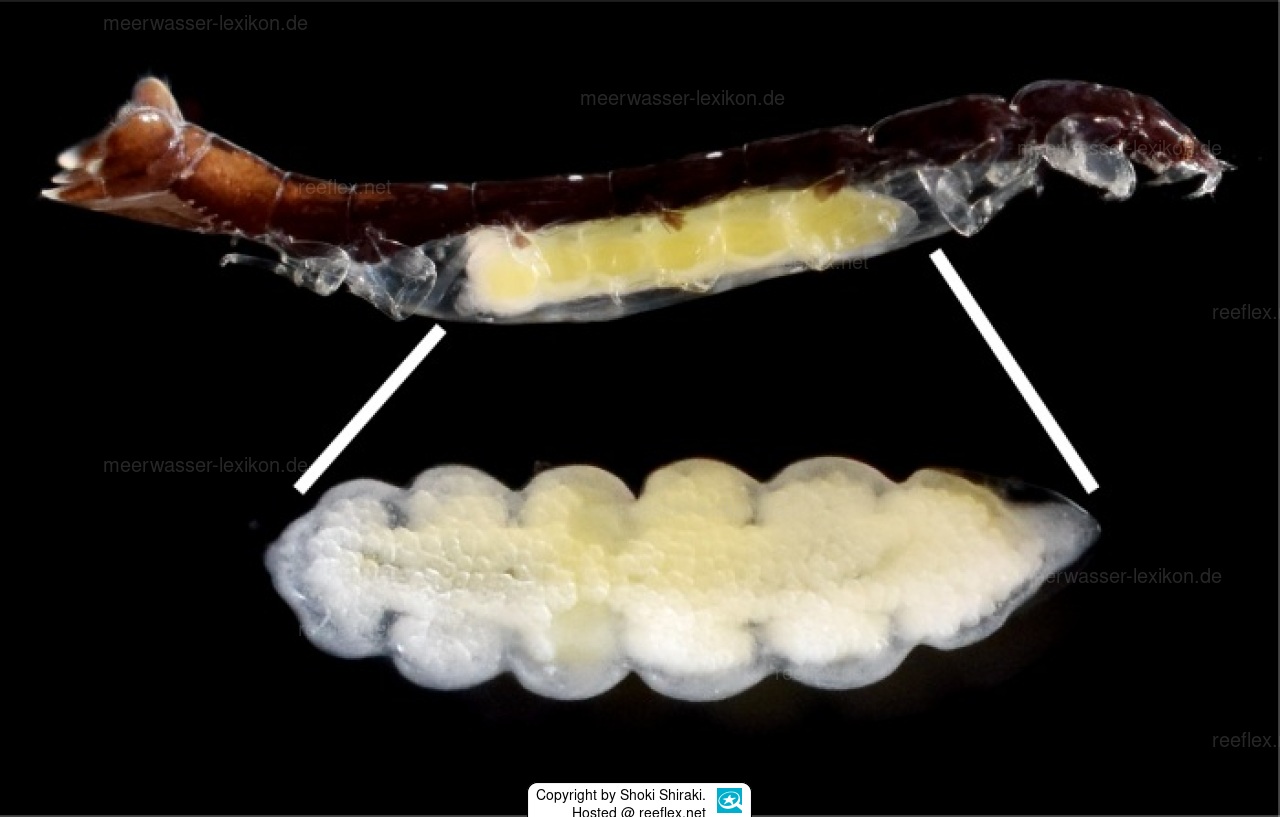
No eggs could be found in the copepod’s marsupium; they were now all lying on the bottom of the aquarium, and a mature female parasite was instead found in the marsupium of the current “host” female, feeding on her body fluids.
How long the parasitic process lasted, and whether it ended with the host’s death, remained unclear in order to preserve the parasite at an early stage.
The body of this parasite is elongated, compressed dorsally, and tapers toward the rear; it measures 3.10 mm in length, and six pairs of lateral protrusions were present on the body.
The head had a pair of eyes and a ventral hook on the posterior side.
Etymology:
The genus name is a combination of “anthura-” (the root of Anthuroidea, the host group) and “-oniscus” (a common suffix for kryptoniscoid genera).
The species name honors Dr. Michitaka Shimomura, who made a significant contribution to the taxonomy of isopods and related groups in Japan.
We would like to extend our special thanks to the two authors of the original description: Dr. Keiichi Kakui, who provided the Seawater Encyclopedia with written permission from the first author, Dr. Shoki Shiraki.
However, more than half of all isopod species live in the ocean, and some marine species have developed parasitic lifestyles.
Others have taken their lifestyle to the extreme and no longer resemble isopods or crustaceans at all.
Anthuroniscus shimomurai is a parasitic marine isopod that feeds off other host isopods and was discovered in 2024.
The new species, known as Shimomura’s bean-shaped isopod or Anthuroniscus shimomurai, is one such example; it parasitizes the brood pouches of other marine isopods.
The parasite has an elongated body—which is rare among parasitic isopods—and is likely an adaptation to the elongated body of its host.
After finding a suitable host isopod, the parasite expels the host’s eggs and spends the rest of its life nestled tightly within the host’s brood pouch. This remarkable parasite was named after Dr. Michitaka Shimomura, who made a significant contribution to the taxonomy of isopods in Japan.
Three host isopods (Mesanthura sp.) were collected at three locations in Japan; the holotype of Anthuroniscus shimomurai is an egg-bearing female measuring 3.10 mm in length, discovered on April 21, 2023, at a depth of 0.5 meters near Kaichu Doro, Uruma, Okinawa, Japan.
Upon initial examination, no parasite was observed.
After a few days, the research team consisting of Drs. Shiraki and Kakui made an astonishing discovery in the laboratory aquarium:
No eggs could be found in the copepod’s marsupium; they were now all lying on the bottom of the aquarium, and a mature female parasite was instead found in the marsupium of the current “host” female, feeding on her body fluids.
How long the parasitic process lasted, and whether it ended with the host’s death, remained unclear in order to preserve the parasite at an early stage.
The body of this parasite is elongated, compressed dorsally, and tapers toward the rear; it measures 3.10 mm in length, and six pairs of lateral protrusions were present on the body.
The head had a pair of eyes and a ventral hook on the posterior side.
Etymology:
The genus name is a combination of “anthura-” (the root of Anthuroidea, the host group) and “-oniscus” (a common suffix for kryptoniscoid genera).
The species name honors Dr. Michitaka Shimomura, who made a significant contribution to the taxonomy of isopods and related groups in Japan.
We would like to extend our special thanks to the two authors of the original description: Dr. Keiichi Kakui, who provided the Seawater Encyclopedia with written permission from the first author, Dr. Shoki Shiraki.

