


 Albert Kang, Philippinen


Info
This species was originally described by van Pesch (1910) from the Indonesian archipelago. He did not designate a holotype and based his description on six specimens, three of which have been lost and one of which is missing from the Siboga Collection register.
The two remaining specimens belong to two different species, one to the recently described species Pseudocirrhipathes mapia from the Zoological Museum Amsterdam, and the other to Cirrhipathes rumphii (specimen Coel. 02599a from the Zoological Museum Amsterdam).
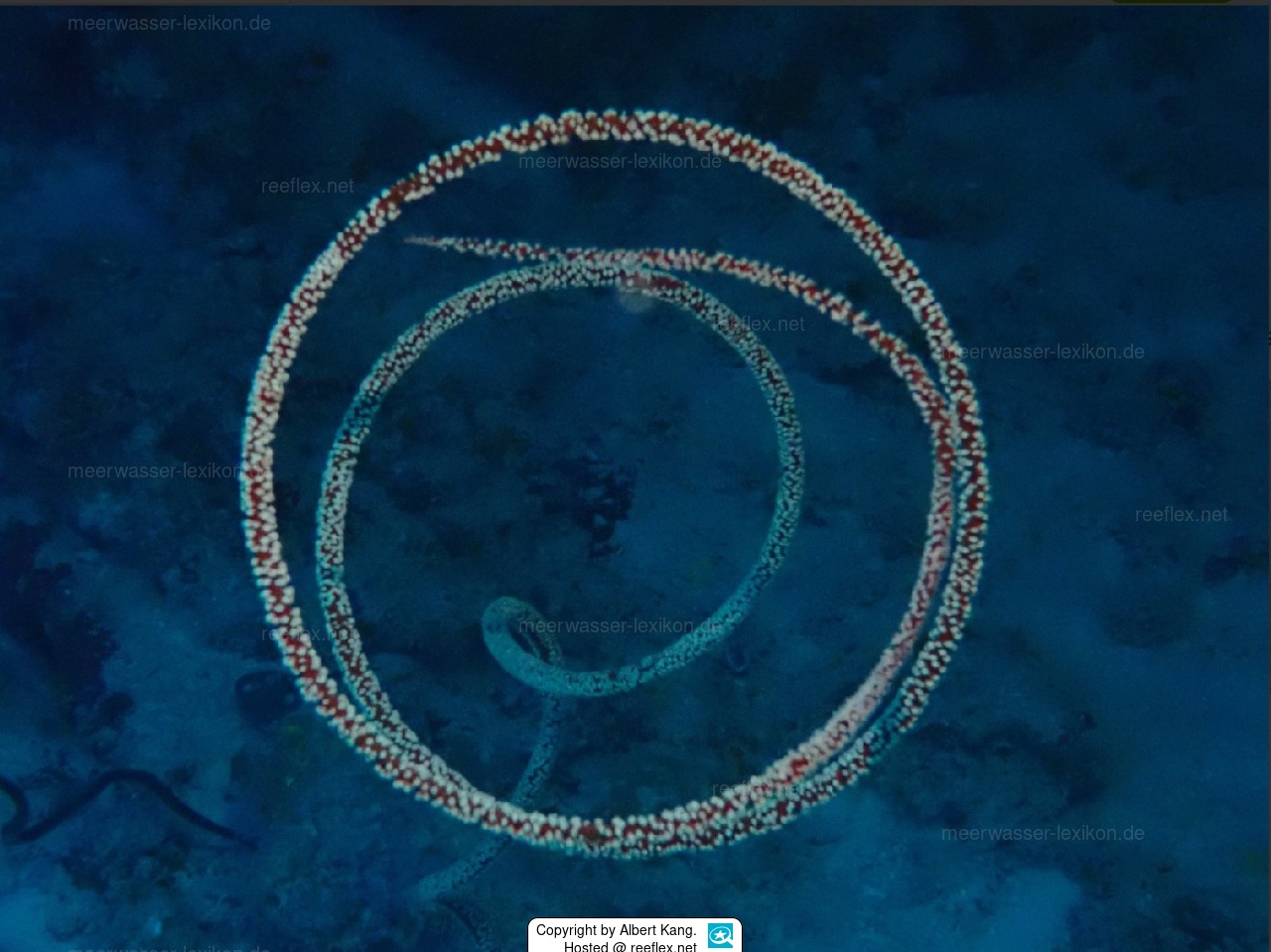
This horn coral is a thin, single-stem colony, the upper part of which has large right-handed coils, which may be loose in some colonies.
The colonies reach a height of about 1.8 meters and begin to coil about 50 cm above the seabed.
The distance between the coils is about 40 cm, their diameter about 20 cm.
The coral has a brown coenenchyme with white polyps, some of which are arranged on only one side of the colony, but never in a single row.
The polyps have a cross-section of up to 2.5 mm and are all densely packed together, so that the coenenchyme between the polyps is sometimes not visible, but their mutual distance can be up to 1.9 mm, with 3-4 pieces per cm.
In vivo, the extended tentacles are long and have round tips.
The color of the coral can be brown and white or completely orange.
Synonyms:
Cirripathes (Eucirripathes) rumphii van Pesch, 1910 · unaccepted
Cirripathes rumphii van Pesch, 1910 · unaccepted (corrected spelling)
The two remaining specimens belong to two different species, one to the recently described species Pseudocirrhipathes mapia from the Zoological Museum Amsterdam, and the other to Cirrhipathes rumphii (specimen Coel. 02599a from the Zoological Museum Amsterdam).
This horn coral is a thin, single-stem colony, the upper part of which has large right-handed coils, which may be loose in some colonies.
The colonies reach a height of about 1.8 meters and begin to coil about 50 cm above the seabed.
The distance between the coils is about 40 cm, their diameter about 20 cm.
The coral has a brown coenenchyme with white polyps, some of which are arranged on only one side of the colony, but never in a single row.
The polyps have a cross-section of up to 2.5 mm and are all densely packed together, so that the coenenchyme between the polyps is sometimes not visible, but their mutual distance can be up to 1.9 mm, with 3-4 pieces per cm.
In vivo, the extended tentacles are long and have round tips.
The color of the coral can be brown and white or completely orange.
Synonyms:
Cirripathes (Eucirripathes) rumphii van Pesch, 1910 · unaccepted
Cirripathes rumphii van Pesch, 1910 · unaccepted (corrected spelling)


