


 Muelly

Info
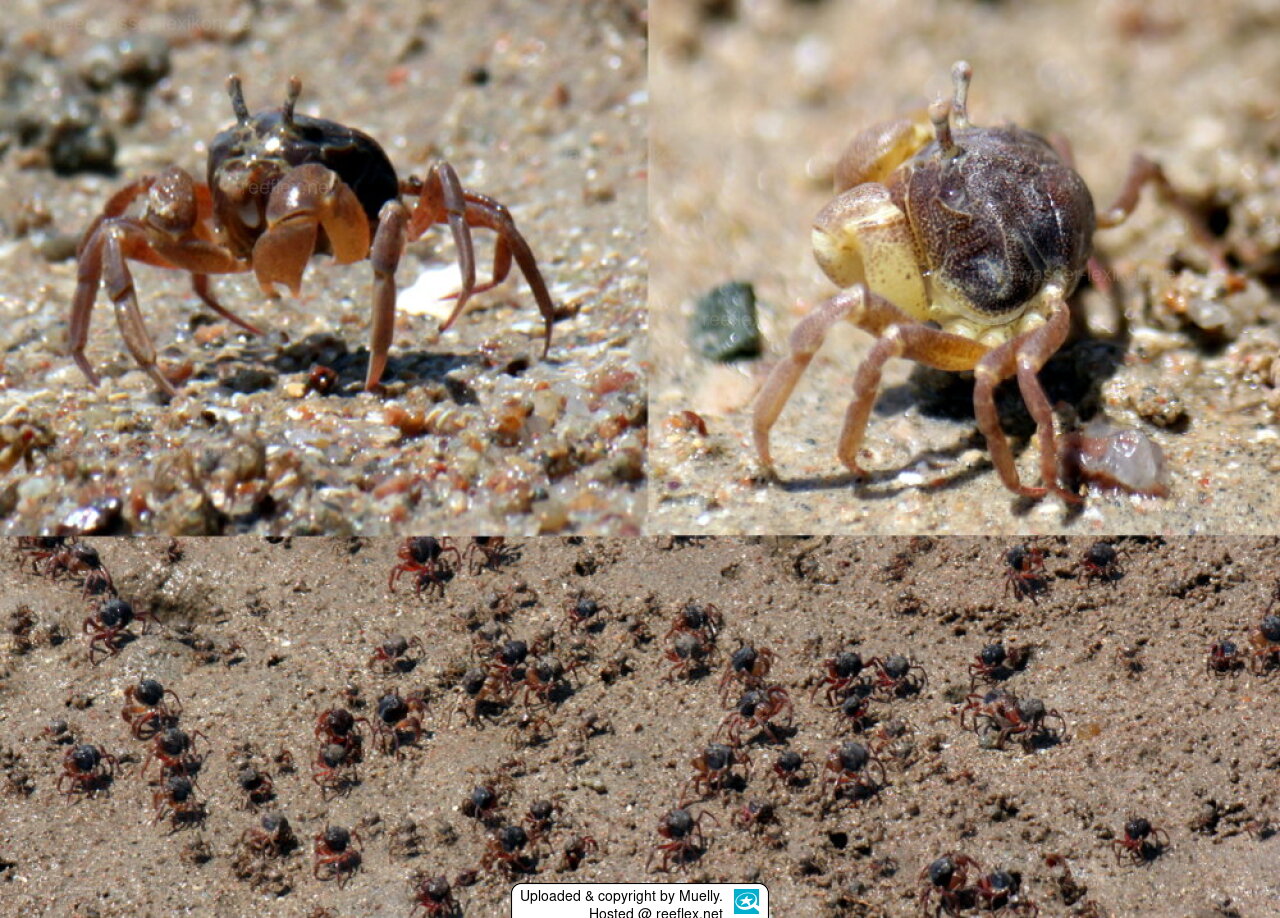
Dotilla sulcata (Forskål, 1775)
During evolution, the adaptation of aquatic organisms to terrestrial life has brought about many changes in their morphology, physiology and behavior. Among aquatic invertebrates, a small group of decapods that live where sea and land meet are unique in that they are truly amphibious, spending part of their lives on land and the other part in water. In addition to some species of ghost crabs (Ocypode), species of Uca, hermit crabs (Coenobita and Virgo), this lifestyle also affects crabs of the genus Scopimera and Dotilla.
Sand bladder crabs of the genus Scopimera and Dotilla are small crabs with a shell diameter of about 1 cm. A special feature is that they have a so-called “gas window” on the underside of the legs.
They are small crabs that live on sandy beaches. They live in small caves in the sand, where they stay at high tide. At low tide, the crabs emerge to the surface of the sand and chew through the sand for food. They feed on detritus and plankton. The material consumed by sandbladder crabs has a very low concentration of organic matter, which is concentrated by ingesting indigestible material.
The sand bladder crabs dispose of the processed sand in the form of small sand balls that cover the beach. These are later broken down again by the incoming tide.
In their sand cave, these crabs wait in an air bubble during the high tide until the next low tide.
Taxonomic history
The first sand bladder crab to be described was Cancer sulcatus (now Dotilla sulcata) by Peter Forsskål in 1775. The genus Scopimera was originally described as a subgenus of Ocypode by Wilhem de Haan in 1833. At the same time, De Haan tried to establish the genus Doto for Forskåls Cancer sulcatus, without realizing that the name was occupied by the mollusc genus Doto. Therefore, in 1858, William Stimpson named this genus Dotilla.
Synonymised names:
Cancer sulcatus Forskål, 1775 · unaccepted > superseded combination
Dotilla affinis Alcock, 1900 · unaccepted > junior subjective synonym
Doto sulcatus (Forskål, 1775) · unaccepted > superseded combination
During evolution, the adaptation of aquatic organisms to terrestrial life has brought about many changes in their morphology, physiology and behavior. Among aquatic invertebrates, a small group of decapods that live where sea and land meet are unique in that they are truly amphibious, spending part of their lives on land and the other part in water. In addition to some species of ghost crabs (Ocypode), species of Uca, hermit crabs (Coenobita and Virgo), this lifestyle also affects crabs of the genus Scopimera and Dotilla.
Sand bladder crabs of the genus Scopimera and Dotilla are small crabs with a shell diameter of about 1 cm. A special feature is that they have a so-called “gas window” on the underside of the legs.
They are small crabs that live on sandy beaches. They live in small caves in the sand, where they stay at high tide. At low tide, the crabs emerge to the surface of the sand and chew through the sand for food. They feed on detritus and plankton. The material consumed by sandbladder crabs has a very low concentration of organic matter, which is concentrated by ingesting indigestible material.
The sand bladder crabs dispose of the processed sand in the form of small sand balls that cover the beach. These are later broken down again by the incoming tide.
In their sand cave, these crabs wait in an air bubble during the high tide until the next low tide.
Taxonomic history
The first sand bladder crab to be described was Cancer sulcatus (now Dotilla sulcata) by Peter Forsskål in 1775. The genus Scopimera was originally described as a subgenus of Ocypode by Wilhem de Haan in 1833. At the same time, De Haan tried to establish the genus Doto for Forskåls Cancer sulcatus, without realizing that the name was occupied by the mollusc genus Doto. Therefore, in 1858, William Stimpson named this genus Dotilla.
Synonymised names:
Cancer sulcatus Forskål, 1775 · unaccepted > superseded combination
Dotilla affinis Alcock, 1900 · unaccepted > junior subjective synonym
Doto sulcatus (Forskål, 1775) · unaccepted > superseded combination

