



 Admin Meerwasser-Lexikon


Info
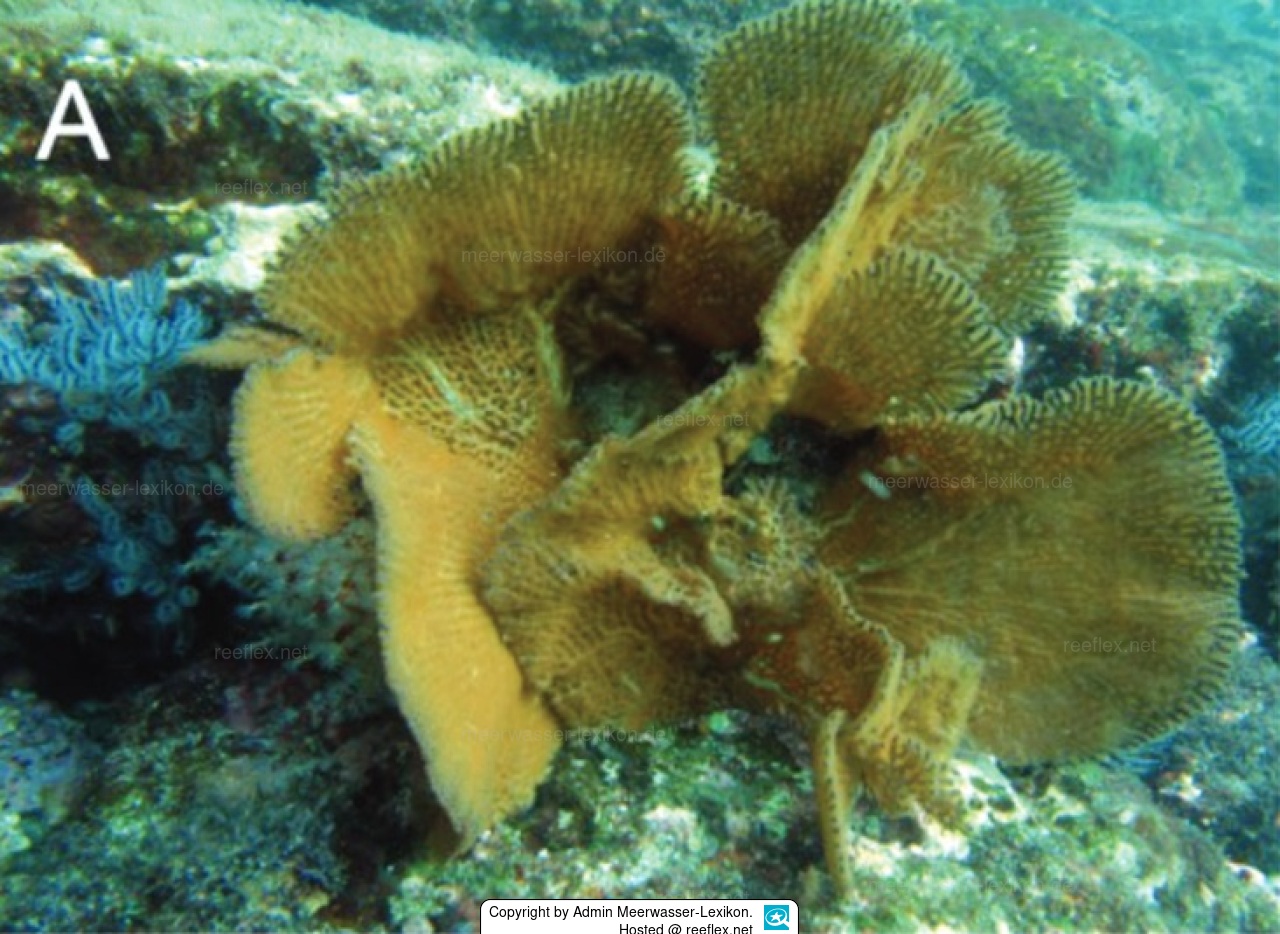
Pacifigorgia firma is an azooxanthellate gorgonian from the East Pacific of Central and South America.
This gorgonian is found on rocky substrates, basalt walls or mudstone and formations in zones strongly influenced by waves.
They are also found in rock crevices and ledges, growing strongly on rocks and can be found upside down, arranged perpendicular to the current.
Colonies are dense, very rigid, of variable shape, usually wider than high, up to 250 mm in height and up to 400 mm in width.
Recommendation - the coral should be kept in a species-specific tank.
Feeding
The majority of gorgonians do not have zooxanthellae and do not live off light. Azooxanthellate gorgonians do not host symbiotic algae that produce nutrients and energy through photosynthesis.
The pumps should be switched off before feeding. In order for the gorgonian to survive in the aquarium, each individual polyp must be fed sufficiently, i.e. daily or 3-4 times a week. Without feeding, the gorgonian will not survive in the aquarium. The polyps need a certain amount of time to absorb the food (granules or dust food (Ultramarin, Cyclop Eeze) or frozen food (lobster eggs, mysis)). If shrimp and fish are present, they will try to steal the food, so it is essential to feed these cohabitants beforehand.
Newly introduced gorgonian sticks can be stimulated with a liquid food, e.g., PolypLab Polyp, to encourage the individual polyps to open. Only then can feeding be carried out.
The better the individual polyps take up the food provided, the better the growth and reproduction rates will be.
Azooxanthellate corals eat suspensions, marine snow, microplankton, and other organic matter, which is their natural food.
Color: beige or yellowish when alive.
Etymology. The species name firmus means strong, stout.
This gorgonian is found on rocky substrates, basalt walls or mudstone and formations in zones strongly influenced by waves.
They are also found in rock crevices and ledges, growing strongly on rocks and can be found upside down, arranged perpendicular to the current.
Colonies are dense, very rigid, of variable shape, usually wider than high, up to 250 mm in height and up to 400 mm in width.
Recommendation - the coral should be kept in a species-specific tank.
Feeding
The majority of gorgonians do not have zooxanthellae and do not live off light. Azooxanthellate gorgonians do not host symbiotic algae that produce nutrients and energy through photosynthesis.
The pumps should be switched off before feeding. In order for the gorgonian to survive in the aquarium, each individual polyp must be fed sufficiently, i.e. daily or 3-4 times a week. Without feeding, the gorgonian will not survive in the aquarium. The polyps need a certain amount of time to absorb the food (granules or dust food (Ultramarin, Cyclop Eeze) or frozen food (lobster eggs, mysis)). If shrimp and fish are present, they will try to steal the food, so it is essential to feed these cohabitants beforehand.
Newly introduced gorgonian sticks can be stimulated with a liquid food, e.g., PolypLab Polyp, to encourage the individual polyps to open. Only then can feeding be carried out.
The better the individual polyps take up the food provided, the better the growth and reproduction rates will be.
Azooxanthellate corals eat suspensions, marine snow, microplankton, and other organic matter, which is their natural food.
Color: beige or yellowish when alive.
Etymology. The species name firmus means strong, stout.

