




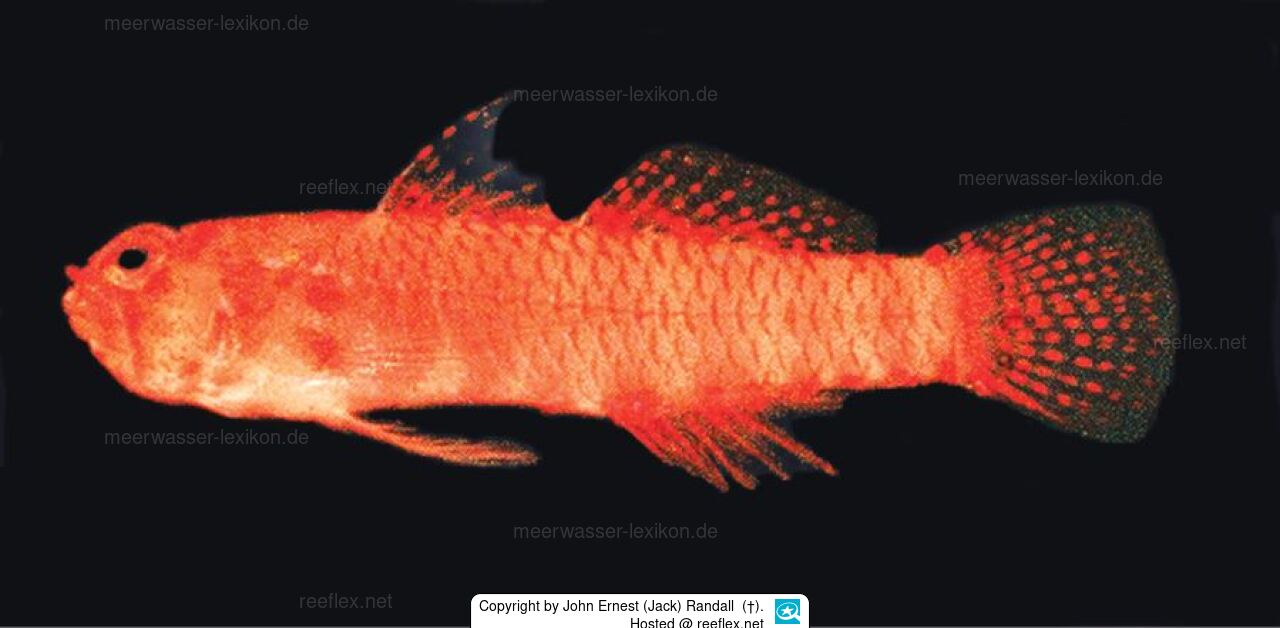
 Dr. John Ernest (Jack) Randall (†), Hawaii


Info
Fiery Dwarfgoby (Greenfield & Randall, 2017)
Sueviota pyrios, a new species of coral-reef dwarfgoby from the Red Sea (Teleostei: Gobiidae)
DAVID W. GREENFIELD, JOHN E. RANDALL
Sueviota is a genus of fish in the family Gobiidae native to the Indian and Pacific Ocean.
Normally the new nano gobies described are in the Eviota or Trimma genera, but for some reason Sueviota is the genus of the hour.
Sueviota pyrios
is described as a new gobiid fish from a single male specimen, 16.5 mm SL, collected from the
Gulf of Aqaba in the Red Sea. It is distinct from other described species of the genus in being bright orange-red in
life, in having two vertically aligned, well-separated, reddish clusters of chromatophores on the pectoral-fin base
(each with a blackish mark in the center of the cluster), the first two spines of the dorsal fin filamentous, 8 dorsal-
fin soft rays, 8 anal-fin soft rays, 16 pectoral-fin rays (all unbranched), the fifth pelvic-fin ray with two branches,
no pelvic frenum, 25 lateral scale rows, and the following cephalic sensory-canal pores: POP, NA, AITO, PITO,
SOT, and AOT. This is the first record of the genus Sueviota from the Red Sea
Systematik:
Biota > Animalia (Kingdom) > Chordata (Phylum) > Vertebrata (Subphylum) > Gnathostomata (Superclass) > Pisces (Superclass) > Actinopteri (Class) > Perciformes (Order) > Gobioidei (Suborder) > Gobiidae (Family) > Gobiinae (Subfamily) > Sueviota (Genus) > Sueviota pyrios (Species)
Jumping guard
A jumping guard prevents (nocturnal) fish from jumping out.
Wrasses, blennies, hawkfishs and gobies jump out of an unprotected tank in fright if their night rest is disturbed, unfortunately these jumpers are found dried up in the morning on carpets, glass edges or later behind the tank.
https://www.korallenriff.de/en/article/1925_5_Jump_Protection_Solutions_for_Fish_in_the_Aquarium__5_Net_Covers.html
A small night light also helps, as it provides the fish with a means of orientation in the dark!
Sueviota pyrios, a new species of coral-reef dwarfgoby from the Red Sea (Teleostei: Gobiidae)
DAVID W. GREENFIELD, JOHN E. RANDALL
Sueviota is a genus of fish in the family Gobiidae native to the Indian and Pacific Ocean.
Normally the new nano gobies described are in the Eviota or Trimma genera, but for some reason Sueviota is the genus of the hour.
Sueviota pyrios
is described as a new gobiid fish from a single male specimen, 16.5 mm SL, collected from the
Gulf of Aqaba in the Red Sea. It is distinct from other described species of the genus in being bright orange-red in
life, in having two vertically aligned, well-separated, reddish clusters of chromatophores on the pectoral-fin base
(each with a blackish mark in the center of the cluster), the first two spines of the dorsal fin filamentous, 8 dorsal-
fin soft rays, 8 anal-fin soft rays, 16 pectoral-fin rays (all unbranched), the fifth pelvic-fin ray with two branches,
no pelvic frenum, 25 lateral scale rows, and the following cephalic sensory-canal pores: POP, NA, AITO, PITO,
SOT, and AOT. This is the first record of the genus Sueviota from the Red Sea
Systematik:
Biota > Animalia (Kingdom) > Chordata (Phylum) > Vertebrata (Subphylum) > Gnathostomata (Superclass) > Pisces (Superclass) > Actinopteri (Class) > Perciformes (Order) > Gobioidei (Suborder) > Gobiidae (Family) > Gobiinae (Subfamily) > Sueviota (Genus) > Sueviota pyrios (Species)
Jumping guard
A jumping guard prevents (nocturnal) fish from jumping out.
Wrasses, blennies, hawkfishs and gobies jump out of an unprotected tank in fright if their night rest is disturbed, unfortunately these jumpers are found dried up in the morning on carpets, glass edges or later behind the tank.
https://www.korallenriff.de/en/article/1925_5_Jump_Protection_Solutions_for_Fish_in_the_Aquarium__5_Net_Covers.html
A small night light also helps, as it provides the fish with a means of orientation in the dark!

